Harleys in Cuba
It is well-known history that a hundred years ago, in 1903, the first Harleys were built in Milwaukee, Wisconsin, USA, at the family home of the Davidson brothers (Arthur, William and Walter), helped by their good friend William Harley.
Harley-Davidsons were imported to Cuba by the hundreds during the Batista era. It was a time of intense North American tourism, when the island is said to have become the brothel of the USA. Typically, this brought along expressions of the American way of life, and so the latest models of cars and motorcycles from the best US brands reached the island immediately. Harleys were also widely used by the island's security forces and police as escorts for the government and visiting dignitaries. Many other units were bought by Cubans for private use.
After the revolution, North American products fell into the undesirable category and Harley-Davidsons were unfortunately among them. Although Commanders Che Guevara and Camilo Cienfuegos were known motorcycle enthusiasts, an old rumour has it that in the early days of the revolution the police Harleys were cut in two with a blowtorch and buried near Santiago, out in Oriente. Others say they were actually run over with a steamroller before being buried, although there are also those who insist it is all old wives' tales and that many of the motorcycles still running in fact belonged to Batista's police. In any case, the last known imports took place in 1960. Casa Berto, the most famous official service centre the brand had in Cuba, also closed for good in the early 60s.
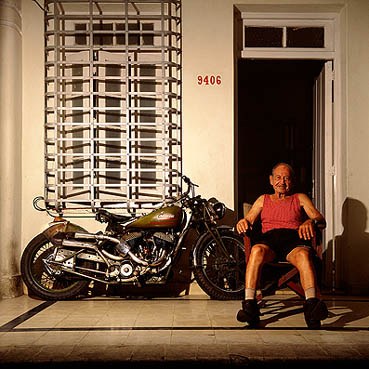
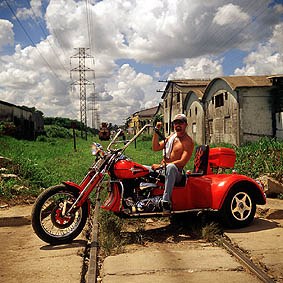
With the embargo, original spare parts stopped reaching Cuba and for a moment it seemed those beautiful machines would be lost. Deep down, this only stimulated the famous Cuban ingenuity. By making their own parts or adapting those of some old Soviet vehicle, the persistent Cuban Harley riders managed to keep these motorcycles in use: models from the 30s, 40s and 50s, of which perhaps more than fifty are still running today.
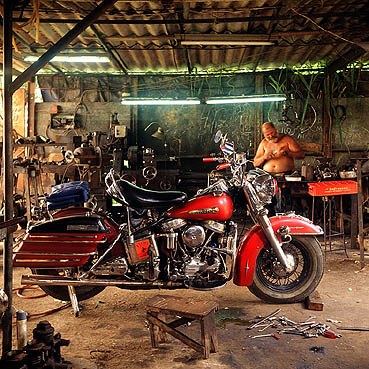
The guru of these tricks was José Lorenzo Cortez, known as Pepe “Milésimas”, who became a true legend when it comes to maintaining a Harley with precarious means. Suffice it to say that every year, on Saint Joseph's Day, a mass motorcycle ride is held in Havana to his grave in the Colón Cemetery. One of his disciples, Sergio Morales, keeps a small workshop open in Luyanó, south of Old Havana, which could be considered the Mecca of Cuban Harleys.
During the 90s, at the start of the “Special Period”, several dozen, perhaps more than a hundred Harleys were bought at ridiculous prices because of the huge devaluation of the peso and taken clandestinely off the island by various foreigners. Cuban law restricts the export of these vehicles, whose owners, for their part, have not hesitated to raise their value in the face of foreign interest.
During the 90s, a handful of motorcycling enthusiasts founded MOCLA, the Cuban Classic Motorcycle Association (in Cuba there are practically no motorcycles that are not classics), not without hard work and with the aim of promoting the love of motorbikes. Alongside it, and more recently, there is a Cuban chapter of LAMA, the Latin American Motorcycle Association, with representation in various parts of the Americas. These associations have enabled some of their members to travel to Daytona or Sturgis, and some are even considering travelling to Milwaukee for the Harley-Davidson centenary. The image of the Cuban Harley rider often contrasts with the Western biker stereotype of the defiant, dirty, white and hairy type who usually camouflages a yuppie or a middle-ranking professional buried in bank payments, forgetting that the legend is made not by the motorcycles but by the people who ride them. Cuban motorcyclists, by contrast, are ordinary, hard-working, clean-shaven and well-mannered people who have managed, with very basic means, to keep their bikes running.
For Cuban Harley riders, their motorcycle is a small treasure that gives them a certain social standing, as well as being their only vehicle in most cases. Written on these Harleys I have photographed is the history of Cuba over the last 60 or 70 years; you need only “read” the images with a little attention and listen to the endless anecdotes their proud owners tirelessly tell. Stories of Batista's Cuba, stories of the Revolution, stories of eternal blockade and necessity that give rise to stories of courage and resilience, sustained by an intense passion. These motorcycles are so bound up with the history of that Caribbean republic that most of them will disappear with the current regime of which, deep down, they are also a product. The passion may be intense, but in the end necessity rules.